
Batteries for Defence Applications - Modern Warfare Needs More and More Batteries
Posted on: in Blog
In the previous blog about batteries for defence applications, we saw how current military conflicts rely increasingly on battery-powered solutions. But in this field, there is no place for balanced, middle-of-the-road batteries. Instead, each application requires specific, often tough specifications from their source of power.
Whilst the majority of defence transportation applications rely on diesel, backed-up with lead acid batteries, electrification by means of rechargeable lithium-ion batteries is gradually replacing less sustainable and lower performance chemistries.
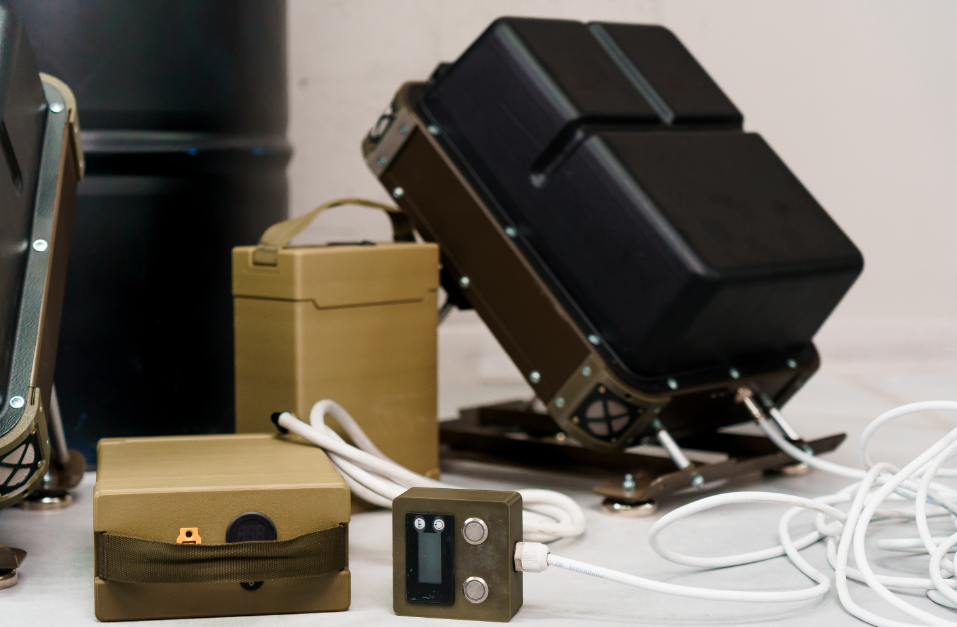
Below is a summary of various, non-transportation, military applications and the expectations on the batteries.
OSCAR (Operational Single-Cell for Accessory Readiness)
OSCAR are rechargeable cylindrical cells packaged in a rubber container, with easy-to-use connectors. They replace disposable batteries in rifle-mounted lasers, thermal scopes and other small helmet-mounted devices. In a simple 1S1P pack configuration, these products have been designed to meet the high instantaneous power needs of next-generation, electronic battlefield enablers. Full operation is certified for all climates, down to -30°C and up to +60°C.
STUB (Small Tactical Universal Battery)
STUB are standardised, “universal”, rechargeable, lithium-ion power source designed to eliminate the need for multiple device-specific batteries. They are also ruggedised battery packs consisting of cylindrical batteries in various configurations up to 4S2P They feature USB-C connectors to power, charge, and swap between, or transfer power to, tactical equipment like GPS, radios, and night vision devices. The STUB series includes 8 sizes (15W to 80W), designed to reduce the logistical burden on soldiers. As for OSCAR batteries, high power capability down to -40°C is a must.
CWB (Conformal Wearable Battery)
CWB are flexible, thin lithium-ion power sources integrated into body armour or vests to power dismounted soldier equipment like radios, GPS and night-vision devices. They improve mobility by distributing weight (~2 lbs) evenly, reduce snag hazards, and often include ballistic protection. The product is a grid of cells in a rubberised casing that flexes at the joints between the cells if necessary. Packaging has been optimised to “self-heal” when pierced by bullet (thanks to elastic stretching of the polymer fibres or reformation of the chemical bonds). Unlike OSCAR and STUB, body heat reduces the need for high performance at low temperature, although, on the other hand, the solution must be very safe, especially in hot climates.
xx90
Sometimes referred to as Tommycans (same form factor and volume as Jerrycans), xx90 are used extensively for high-energy, portable power in harsh environments, powering over 100 different applications: military communications 9 tactical radio systems); unmanned systems (drones, robots, unmanned aerial and underwater vehicles); sensors and imaging devices; weapon systems (Directed-Energy Weapons including laser or microwave systems); integrated soldier systems, such as “Land Warrior”… They are a standard in military technology, often used to replace older nickel-cadmium (NiCd) and nickel-metal hydride (NiMH) batteries due to their higher capacity and lower weight. In combat situations, xx90’s are recharged away from the field of battle (100 km) and delivered by unmanned ground vehicles. Due to their constant use on the field, a very low self-discharge is required from the xx90 batteries powering these systems.
6T
6T batteries are standardised, high-performance power units widely used for both traditional vehicle starting (armoured vehicles and tanks), and advanced, high-power applications, offering significant weight savings and energy density improvements over conventional lead-acid batteries. They are used for "Silent Watch" operations, powering electronic surveillance, weapon systems, and communication equipment for extended periods while the vehicle engine is turned off. 6T also provide power for ground military robotics and Unmanned Ground Vehicles (UGVs). Finally, they act as micro-grid energy storage banks in forward operating bases. As opposed to xx90 which have a few 100Wh of energy, 6T packs can usually provide several kWh. Long-term operation and high cycle life are key specifications for 6T batteries.
CASES (Common Affordable Safe Energy Storage)
CASES batteries including advanced chemistries for utilisation in high-performance durable, and secure energy needs across land, sea, but mainly air. Individual battery modules with several kWh of energy are integrated in larger deployments creating MWh-scale systems to support multi-day power for military bases. They can also power larger unmanned aerial vehicles, silent watch systems, wearable soldier tech, electric tactical vehicles, and base microgrids. The key metric for CASES batteries is a high energy density.
To summarise, no battery chemistry can adequately power each of the various applications encountered in defence. Instead, specialised rechargeable solutions with high safety, energy density, power, cycle life or temperature tolerance will find their match.